

Introduction: When the Silence of the Night Was Shattered
In the stillness of early Saturday morning, Venezuela experienced a moment that may define its modern military and political history. Around 2 a.m. local time, explosions erupted across the country’s northern region, sending shockwaves through coastal towns, strategic ports, and military installations surrounding Caracas. For civilians, it was a frightening interruption of sleep. For analysts and governments around the world, it was a signal that something far more deliberate was unfolding.
This was not chaos. It was choreography.
The United States, in a highly coordinated military operation reportedly aimed at apprehending President Nicolás Maduro and his wife, executed precision strikes against select Venezuelan military assets. These strikes were not random. They followed a clear strategic logic: neutralize air defenses, disrupt communications, and cripple logistics—without leveling civilian landmarks or symbolic political buildings.
Perhaps the most striking detail of all was what remained untouched. The Miraflores Palace, the seat of Venezuelan political power and a symbol recognized worldwide, showed no signs of damage. That absence alone reveals more than a thousand words ever could.
This article breaks down exactly what the U.S. targeted in Venezuela, why those targets mattered, and what it all means going forward—not just for Venezuela, but for regional and global security.
The Strategic Logic Behind the Operation
Modern military operations are no longer about overwhelming force alone. They are a
bout control. Control of airspace. Control of information. Control of movement. The U.S. operation in Venezuela reflected this shift perfectly.
Instead of striking population centers or political icons, the focus was on infrastructure that enables military power to function behind the scenes. Think of it like pulling the plug on a machine rather than smashing the machine itself. Once the power is gone, everything else slows, stops, or collapses.
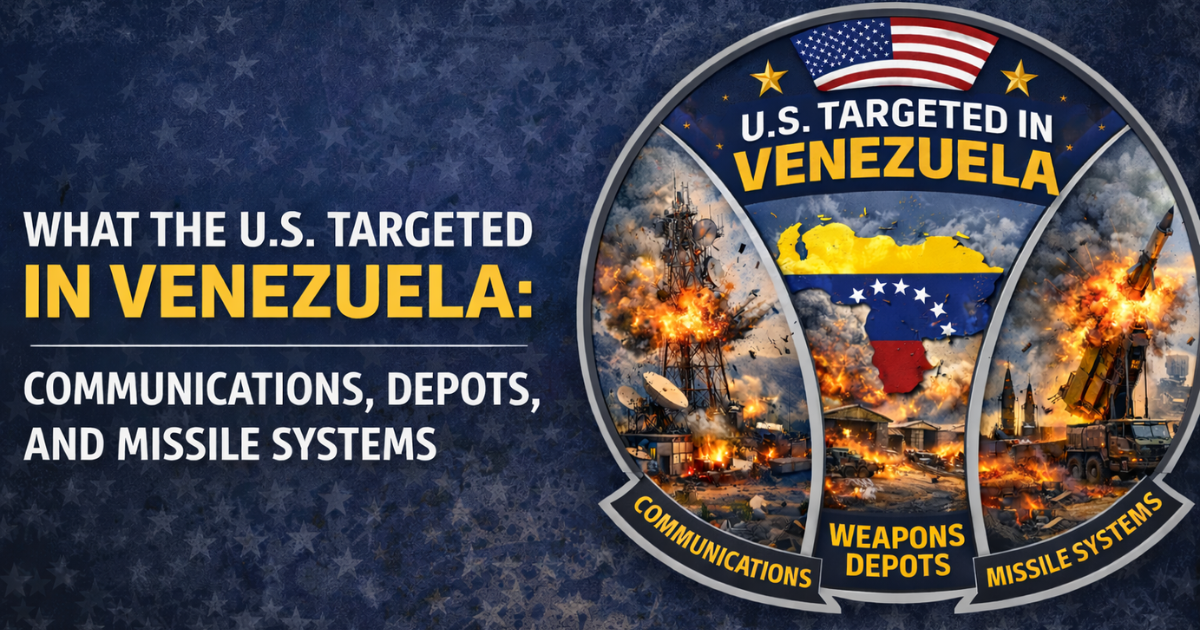
By targeting surface-to-air missile systems, communications complexes, and depots, U.S. forces attacked the very foundations of Venezuela’s defensive posture. These are not glamorous targets, but they are indispensable.
Timeline: How the Strikes Unfolded
The first reports of explosions surfaced around 2:00 a.m. local time. Within minutes, social media platforms filled with videos showing flashes of light, distant booms, and rising smoke. Coastal towns such as Higuerote and La Guaira were among the first areas affected.
As the night progressed, strikes extended inland toward Caracas, with multiple confirmed hits around military installations. Analysts later pieced together the sequence by matching videos with satellite imagery, allowing a detailed reconstruction of events.
The timing was deliberate. Early morning hours maximize surprise, reduce civilian movement, and catch military systems during periods of lower readiness. In military planning, darkness is not just cover—it is opportunity.
Coastal Targets: Why the Caribbean Shoreline Mattered
Higuerote Airport: Neutralizing Air Defense at the Source
One of the clearest and most significant strikes occurred at an airport in the coastal town of Higuerote. Video footage showed a surface-to-air missile system positioned near a damaged aircraft and airport buildings. Military experts identified the system as a Russian-supplied BUK missile platform.
Satellite imagery from the European Space Agency later confirmed a crater at the end of the runway—perfectly aligned with the missile system’s location in the videos.
This was not accidental placement. Airports serve dual roles in military strategy: logistical hubs and defensive nodes. Positioning air defense systems near runways protects aircraft while simultaneously deterring enemy air operations. Destroying both the missile system and damaging the runway effectively neutralized the entire facility in one move.
La Guaira Port: A Strategic Unknown
At La Guaira, Venezuela’s most important port, a massive explosion sent thick smoke into the air. While analysts have yet to conclusively determine what was targeted, the implications are serious.
Ports are arteries. They move fuel, equipment, food, and spare parts. Disrupting a port—even briefly—can paralyze supply chains and slow military response times. Whether the strike hit a depot, fuel storage, or a logistics facility, the message was unmistakable: maritime access points are vulnerable.
Why Surface-to-Air Missile Systems Were a Priority
Understanding the BUK System
The BUK missile system is a mobile, radar-guided surface-to-air defense platform capable of engaging aircraft, helicopters, drones, and cruise missiles. Unlike fixed installations, BUK systems can be repositioned quickly, making them harder to track and destroy.
In military terms, these systems act like invisible fences in the sky. They restrict airspace, force aircraft to fly higher or avoid certain areas, and dramatically increase risk for helicopters and surveillance planes.
Removing the Shield Before the Sword
Any air-heavy operation begins with neutralizing air defenses. Without doing so, aircraft are flying blind and exposed. By destroying BUK systems at Higuerote and La Carlota Air Base, U.S. forces effectively removed Venezuela’s ability to contest the airspace during the operation.
This step alone reshaped the battlefield. Once air defenses are gone, everything else becomes easier—surveillance, transport, precision strikes, and extraction.
Caracas: The Capital Under Strategic Pressure
La Carlota Air Base
Located in the heart of Caracas, La Carlota Air Base is one of the most strategically sensitive military installations in Venezuela. Striking here carried both tactical and psychological weight.
The destruction of a BUK missile system at La Carlota weakened air defense coverage over the capital itself. Air bases are not just about aircraft—they house command centers, maintenance units, and rapid response teams. Damage to one component ripples through the entire system.
El Volcán Communications Complex
In the southeastern part of Caracas, atop a mountain ridge, lies the El Volcán communications complex. This site housed antennas and relay stations used to transmit military communications across long distances.
Videos showed several buildings destroyed, though it remains unclear whether all antennas were rendered non-functional. Still, destroying the support structures beneath those antennas can be just as effective.
High ground equals power in communications. Remove it, and the signal weakens. Orders slow. Confusion spreads.
Fuerte Tiuna: Venezuela’s Military Core
Why Fuerte Tiuna Was Central
Fuerte Tiuna is the largest and most important military complex in Venezuela. It houses command headquarters, logistics facilities, training grounds, and vehicle depots. Any operation aimed at degrading Venezuelan military capacity would inevitably focus here.
Satellite imagery from data-satellite company Vantor showed at least four buildings destroyed across three locations within the complex.
Vehicle Depots and Logistics Facilities
One of the destroyed buildings was identified as a structure used to store large vehicles. The explosion completely leveled it, with smoke still rising hours later.
This kind of target is devastating in the long term. Vehicles are not just transport—they move troops, weapons, fuel, and supplies. Without them, operations slow to a crawl.
Mountain Road Access Points
Two additional strikes occurred along a remote road leading into Fuerte Tiuna. One building appeared to function as an entrance checkpoint, complete with a helicopter pad. The road itself is closed to the public, highlighting its military importance.
Interestingly, a large building between the two destroyed sites was left untouched. This selective targeting reinforces the idea that the operation was guided by precise intelligence rather than broad destruction.
Communications as a Battlefield
In modern warfare, information is as lethal as any weapon. Communications infrastructure is the nervous system of the military body. Disrupt it, and coordination collapses.
By striking communications complexes and relay buildings, U.S. forces likely aimed to:
-
Delay orders
-
Isolate commanders
-
Disrupt real-time coordination
-
Increase confusion during critical moments
Even temporary outages can have lasting psychological effects. Commanders may hesitate, unsure whether systems are secure or compromised.
What Was Not Targeted: Miraflores Palace
Air defense systems
The absence of damage to Miraflores Palace is one of the most telling details of the operation. As the presidential palace, it is both politically and symbolically powerful.
Not striking it suggests restraint—and strategy.
Targeting Miraflores would have sent a message of regime overthrow. Avoiding it framed the operation as a military action, not an act of political annihilation. This distinction matters greatly in international law, diplomacy, and public perception.
Scale of the U.S. Operation
According to Gen. Dan Caine, chairman of the Joint Chiefs of Staff, the mission involved more than 150 aircraft, including:
-
Fighter jets
-
Bombers
-
Surveillance aircraft
-
Intelligence platforms
-
Helicopters
Coordinating such a force requires flawless planning. Every aircraft type plays a specific role, and timing must be exact. One mistake can unravel the entire operation.
The Role of Satellite Intelligence and Media Analysis
Much of what we know today comes from open-source intelligence. Journalists and analysts matched videos with satellite images, confirming strike locations and damage.
This highlights a new reality: military operations now unfold under constant digital observation. Satellites, smartphones, and social media ensure that very little stays hidden for long.
Global and Regional Implications
Russia’s Quiet Stake
The destruction of Russian-supplied systems inevitably draws attention from Moscow. Even without official statements, the loss of advanced hardware sends a message about vulnerability.
Latin America Watches Closely
For neighboring countries, the operation raises serious questions about regional stability and precedent. It underscores how quickly tensions can escalate into direct military action.
What This Means for Venezuela
In the immediate term, Venezuela faces:
-
Reduced air defense capability
-
Disrupted communications
-
Damaged logistics and infrastructure
In the long term, rebuilding will be costly and time-consuming—especially given the country’s existing economic challenges.
Conclusion: Precision Over Chaos
The U.S. strikes in Venezuela were not about shock and awe. They were about precision, control, and calculated restraint. By targeting missile systems, communications hubs, and depots—while avoiding civilian landmarks—the operation aimed to dismantle capability without igniting total war.
History will likely remember this not for what was destroyed, but for how deliberately it was done.
FAQs
1. Why were missile systems targeted first?
To secure air superiority and protect U.S. aircraft.
2. Why was Miraflores Palace untouched?
To avoid civilian escalation and political symbolism.
3. What role did satellites play?
They confirmed targets, damage, and strike accuracy.
4. Why are communications targets so important?
They control coordination and decision-making.
5. What are the long-term effects for Venezuela?
Weakened military readiness, economic strain, and heightened instability.